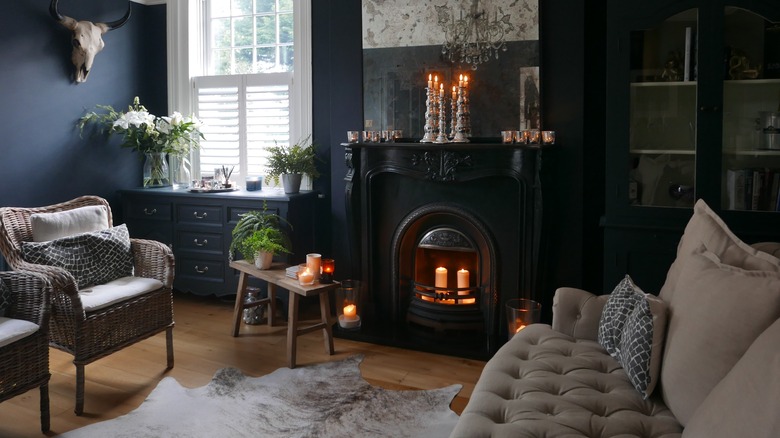
A living room can carry more depth and softness than a hallway or kitchen because it does not need to be bright and efficient all day. It can hold shadow, books, old furniture, a deep sofa and a fire without becoming inconvenient.
The danger is making it so dark and decorated that nobody wants to sit in it. The best rooms feel gathered rather than themed.
Give the room one place to look
A fireplace is the obvious centre in an old cottage, but it does not have to be working. A chimney breast, a large old mirror, a bookcase or a broad window can all give the room a visual anchor.

Once there is a focal point, the furniture can gather around it. That immediately feels more domestic than pushing every chair against a wall to leave an empty stage in the middle.
Gloucester Road in Malmesbury, sold through Inigo, uses deep Studio Green around a sitting room centred on a chimney breast and wood burner. Parquet, built-in seating and stained glass give the dark colour plenty to work with.
Dark walls need warm things beside them
Deep green is particularly effective with worn oak, walnut, brick, terracotta, brass and faded red. Burgundy and oxblood upholstery can look almost luminous against green without becoming bright.
Charcoal and brown-black can be beautiful too, but give them material contrast: a pale plaster chimney breast, an old rug, cream linen, red timber, books or plants.
A room full of uniformly dark modern surfaces often looks flatter than a room with fewer dark things but more varied texture.
Rugs make darkness feel warm
A patterned rug can carry red, rust, faded blue, brown and cream into the room without the walls having to do all the work.
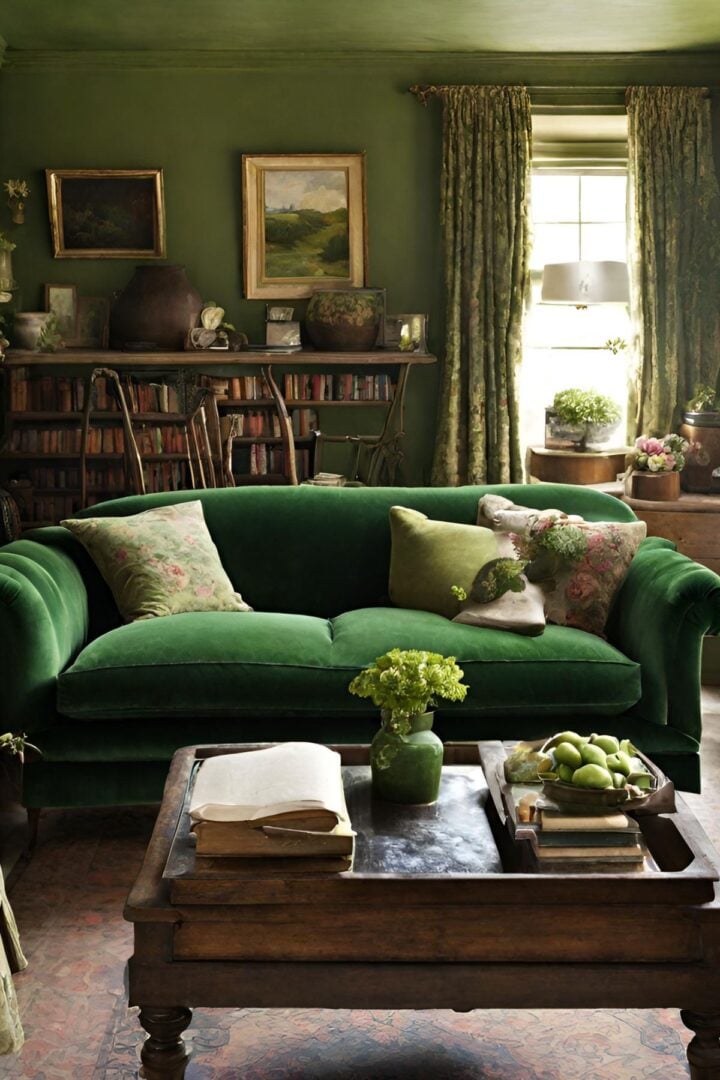
Old Persian-style, kilim and floral rugs are especially useful because they already contain variation and wear. They also soften floorboards and help a seating group feel like one place rather than several unrelated pieces of furniture.
If the room is small, do not buy a tiny rug simply because it is cheaper. A rug that reaches under at least the front feet of the main seating usually makes the room feel calmer and more settled.
Books are decoration only because they are books
A shelf of books already has colour, texture and irregularity. There is no need to turn the spines backwards or organise them into a perfect monochrome display.
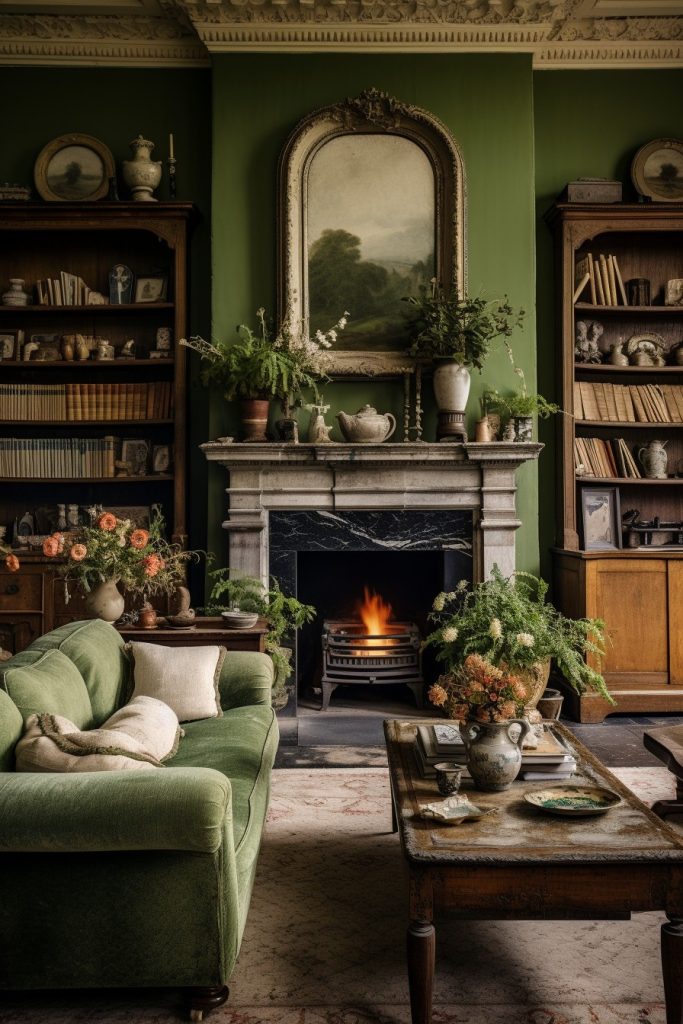
Mix books with useful objects: a lamp, framed photograph, small pot, box or vase. Leave some breathing room. The aim is a shelf someone uses, not a prop wall.
Connect the room to the garden
Ferns, ivy, pothos and larger leafy plants can make a dark room feel connected to the garden rather than detached from it. Deep green walls become a background rather than a statement when real foliage is in front of them.

Use the actual light conditions. A large plant that struggles beside a north-facing cottage window will not become happier because the pot is attractive.
Dried seed heads, branches and hydrangeas can bring the same irregular shapes where living plants are impractical.
Light from several places
One central ceiling light tends to flatten a room. A floor lamp beside a chair, a table lamp by the sofa, a pair of wall lights and the fire create overlapping pools instead.
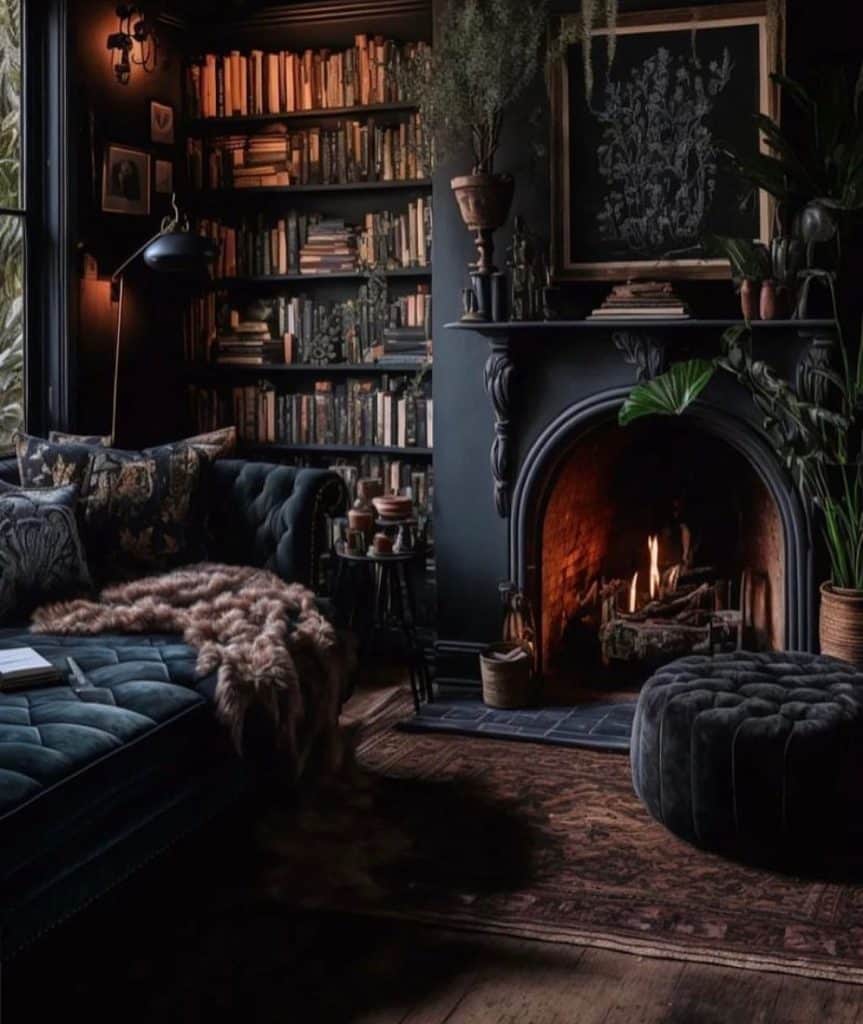
That means you can see what you are doing without exposing every corner equally. It is one of the easiest ways to make a modern room feel more layered.
Warm bulbs matter, but shade material matters too. Linen, pleated paper, opal glass and parchment-like shades soften the source and make dark paint feel warmer.
Mix furniture periods
An old chest beside a modern sofa is often more believable than a full matching suite of reproduction furniture.
Look for shape, scale and material rather than a label. A low oak table, Victorian side chair, leather footstool, 1930s cabinet or old pine cupboard can all work if the room has enough common texture and colour to hold them together.
Matching every timber finish is rarely necessary. In a genuinely old room, furniture arrived at different times.
Keep the television
A television is not a moral failure. Put it where it can be watched comfortably and let the rest of the room carry the atmosphere.
Dark walls often make a black screen recede better than pale walls do. A low old cabinet can hold equipment if the proportions work. There is no need to conceal the television behind fake bookcases or theatrical panels unless you genuinely enjoy doing that.
The room should look good when untidy
A useful test is whether the room still works with a blanket left on the sofa, three books on the table and a mug by the chair.
Cottage Goth should tolerate life. In fact, it usually looks better once a little life has happened to it.
Sources and further looking
- Inigo: Gloucester Road — Studio Green, wood burner, parquet and stained glass.
- Inigo: Harrow Road — deep green sitting room with original fireplace and shelving.
- Inigo: Aubrey Cottage — deep red snug, dark floorboards and an original fireplace.