Owls arrive on aesthetic moodboards trailing centuries of symbolism. Living birds vary sharply in habitat, call, flight and face shape; those clues reveal far more than the generic outline of “an owl”.
Britain has five regularly occurring owl species. Tawny and barn owls are a useful place to start because they are both familiar and frequently confused in popular imagery.
The classic hoot belongs to tawny owls
The famous “twit-twoo” is not usually one owl making a two-part phrase. The Woodland Trust explains that the female gives a sharp “ke-wick” and the male answers with the wavering hoot.
Tawny owls are strongly associated with broadleaved woodland but also occur in parks, churchyards and towns where mature trees provide suitable habitat.
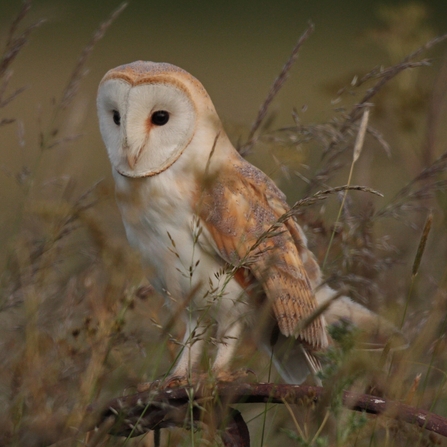
Barn owls do not give the classic hoot
Barn owls make shrill screeches, hisses and other harsh calls. They are pale underneath with a heart-shaped face and are most strongly associated with open farmland, rough grassland and field edges rather than deep woodland.
Their low quartering flight over grass is often more diagnostic than a distant pale glimpse.
Long-eared owls are secretive woodland birds
Long-eared owls have orange eyes and long feather tufts when those tufts are raised. The Barn Owl Trust describes them as strongly nocturnal birds of woodland and farmland; a winter communal roost in dense cover is often easier to find than a hunting bird.

Short-eared owls hunt over open ground
Short-eared owls are mottled brown with yellow eyes and small tufts that can be difficult to see. They hunt over moorland, marsh and rough grassland, often during daylight. In winter, continental birds join the British population, making exposed coastal and wetland ground especially useful places to look.

Little owls are small, squat and introduced
The Little Owl is not native to Britain: BTO records its introduction from continental Europe in the late nineteenth century. It is scarcely larger than a Song Thrush, with yellow eyes, pale brows and a compact shape. Look on veteran trees, fence posts and telegraph poles around farmland, parkland and orchards.
,.jpg)
Habitat narrows the possibilities
A large pale owl hunting low over rough grass at dusk suggests barn owl. A rounded brown owl calling from mature woodland suggests tawny. Little owls often sit visibly on posts and trees; short-eared owls may hunt openly by day; long-eared owls are much harder to see.
Identification should combine several clues rather than rely on colour alone. Retaining mature trees where safe, rough grassland and dense winter cover also protects the places that make those clues meaningful.
Do not bait or crowd an owl for a photograph
Watch from a distance, especially around nest sites and roosts. Playback calls and baiting can disturb birds and alter behaviour.
A silhouette crossing naturally at dusk is a better encounter than a staged close-up bought at the bird's expense.
.jpg)

_-_geograph.org.uk_-_419204.jpg)